
Table of Contents
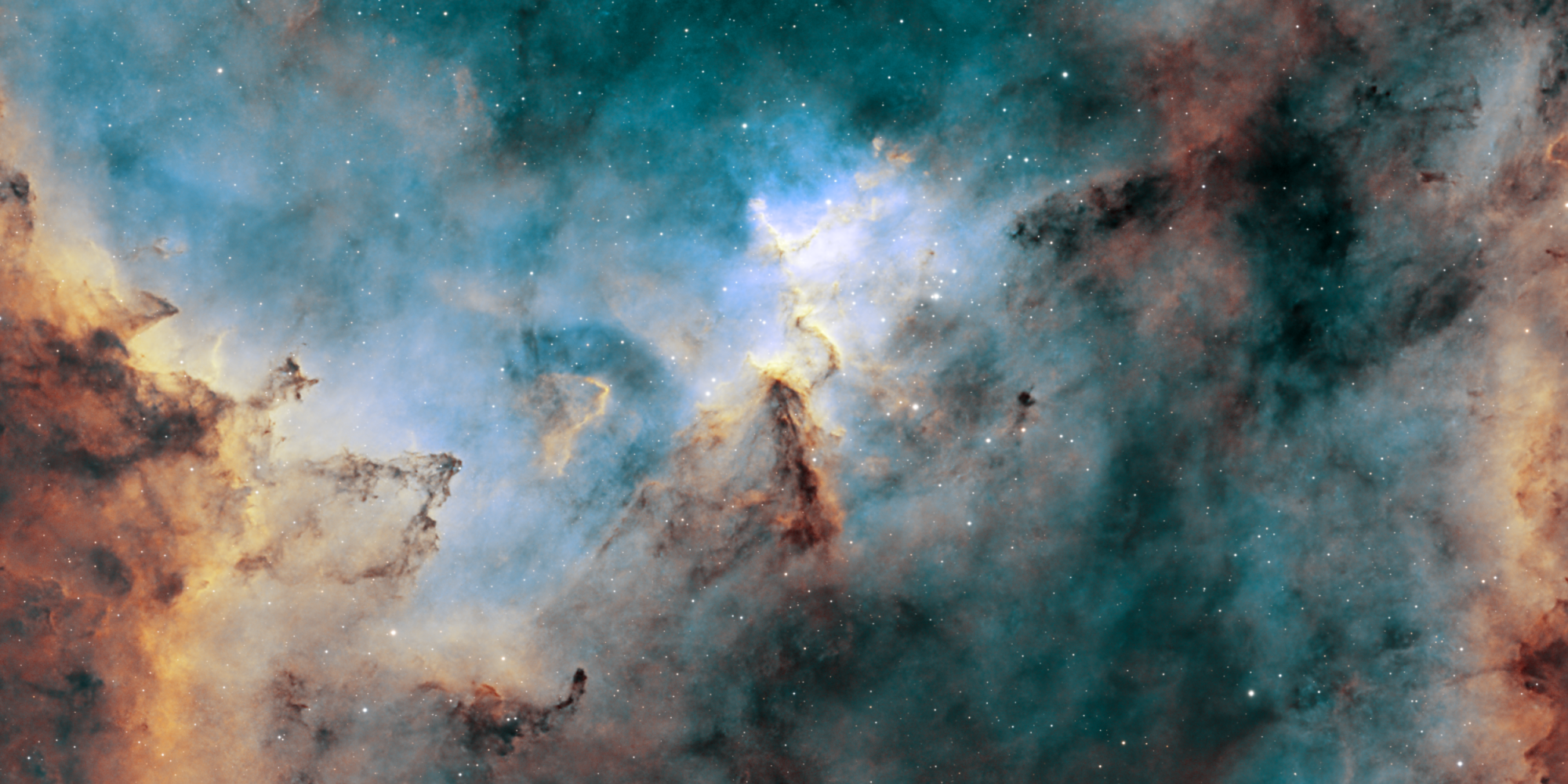
Nestled deep within the glowing folds of the Heart Nebula (IC 1805) in the constellation Cassiopeia, lies a stunning open star cluster known as Melotte 15. Often referred to as the “Heart of the Heart,” this young and dynamic cluster is a prime example of stellar birth and interaction within a nebular environment. Located approximately 7,500 light-years from Earth in the Perseus Arm of the Milky Way, Melotte 15 offers astronomers a vivid laboratory for studying star formation, stellar winds, and the sculpting of interstellar matter.
Melotte 15 – the heart of the heart nebula
Melotte 15 was cataloged by Philibert Jacques Melotte in 1915 as part of his compilation of 245 star clusters. However, the region itself was first observed by William Herschel in 1787. The cluster is also known by the designation Collinder 26, and it resides at the very center of IC 1805, a vast emission nebula spanning roughly 150 light-years across.
Stellar Composition and Age
Melotte 15 is a very young cluster, with an estimated age of just 1.5 million years. It contains a mix of massive O-type stars, some of which are 20 to 50 times the mass of our Sun, alongside numerous smaller, dimmer stars that are only a fraction of solar mass. These massive stars are extremely hot and luminous, emitting intense ultraviolet radiation that ionizes the surrounding hydrogen gas, causing it to glow in the characteristic red hues seen in emission nebulae.
The presence of these massive stars also means that Melotte 15 is a short-lived cluster in astronomical terms. O-type stars burn through their nuclear fuel rapidly and typically end their lives in supernova explosions within a few million years. These explosive events contribute to the enrichment of the interstellar medium and can trigger further star formation in nearby regions.
Nebular Interaction and Sculpting
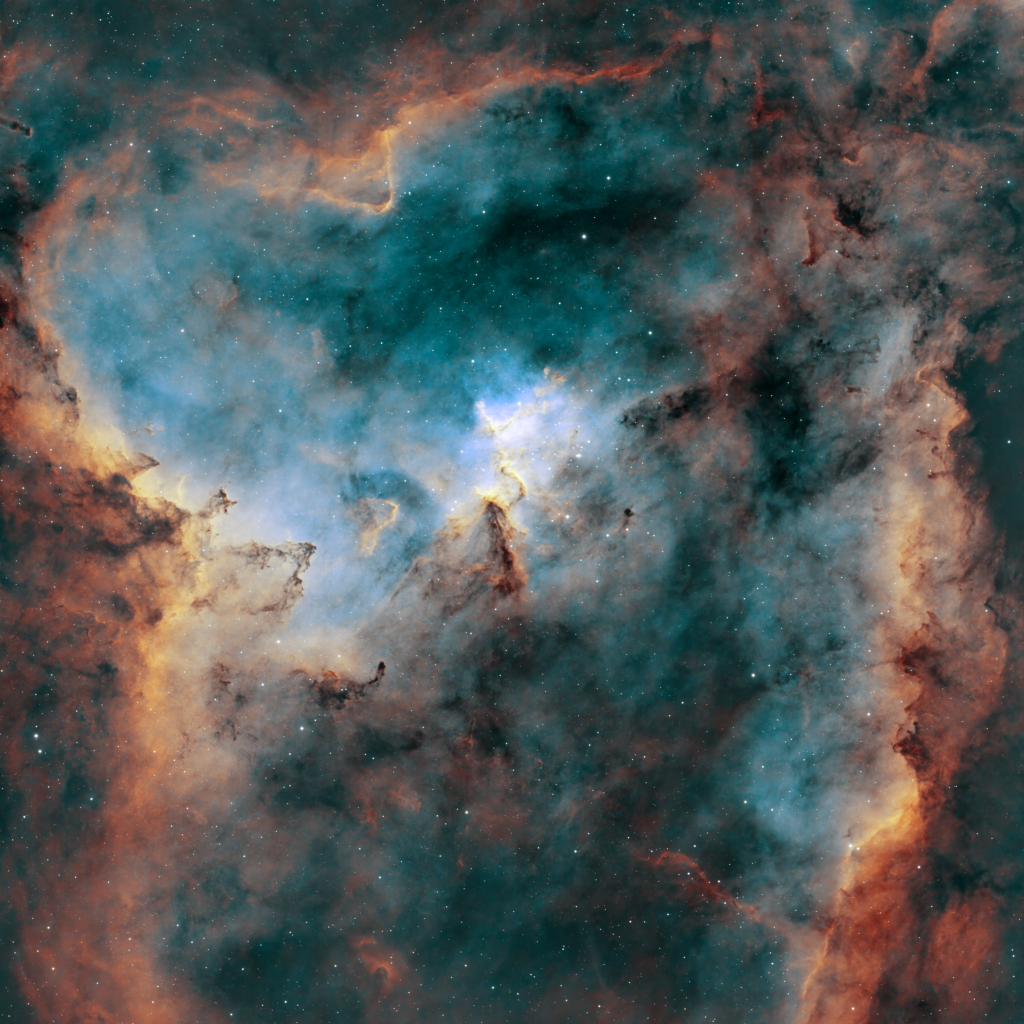
One of the most visually striking aspects of Melotte 15 is its interaction with the surrounding nebula. The stellar winds and radiation pressure from the cluster’s massive stars actively shape the surrounding gas and dust, creating pillars, ridges, and cavities within the nebula. These features are reminiscent of the famous “Pillars of Creation” in the Eagle Nebula, though on a different scale.
The glowing gas in IC 1805 is primarily composed of ionized hydrogen (Hα), sulfur (SII), and oxygen (OIII). In narrowband imaging, these elements are often mapped using the Hubble Palette, where sulfur is rendered in red, hydrogen in green, and oxygen in blue. This technique reveals the complex structure and energetic processes at play within the nebula.
Capturing Melotte 15
For amateur and professional astronomers alike, Melotte 15 is a popular target due to its rich structure and vibrant colors. It is best observed during the autumn and winter months in the Northern Hemisphere, when Cassiopeia is high in the sky. Long-exposure astrophotography using narrowband filters can reveal the intricate details of the cluster and its surrounding nebula, making it a favorite among deep-sky imagers.
This image is composed of 132 subs each 180 second exposures, yielding a total for 6 hours and 36 minutes. All the subs were recorded through the Optolong L-Ultimate filter which is a dual narrowband filter that limit light hitting the sensor to Halpha and Oiii.


Concluding remarks
Melotte 15 is more than just a beautiful cluster—it is a dynamic and evolving region that encapsulates the processes of stellar birth, interaction, and death. Its massive stars illuminate and sculpt the Heart Nebula, offering a glimpse into the powerful forces that shape our galaxy. As telescopes and imaging techniques continue to advance, Melotte 15 will remain a focal point for exploring the mysteries of star formation and the lifecycle of stellar systems.
The Optolong L-Ultimate filter has been an excellent improvement see my previous image of IC 1805 here.
Facts on Melotte 15
Right Ascension: 02 33 22
Declination: +61 33 36
Distance: 7500 light-years
Apparent visual magnitude: 6.50
Apparent visual dimension: 2.50×2.50° (IC 1805)
Constellation: Cassiopeia
Nebula radius: 165 light-years (IC1805)
Names: Melotte 15, Collinder 26, IC 1805 (Heart Nebula), SH2-190, Running Dog Nebula