
Table of Contents
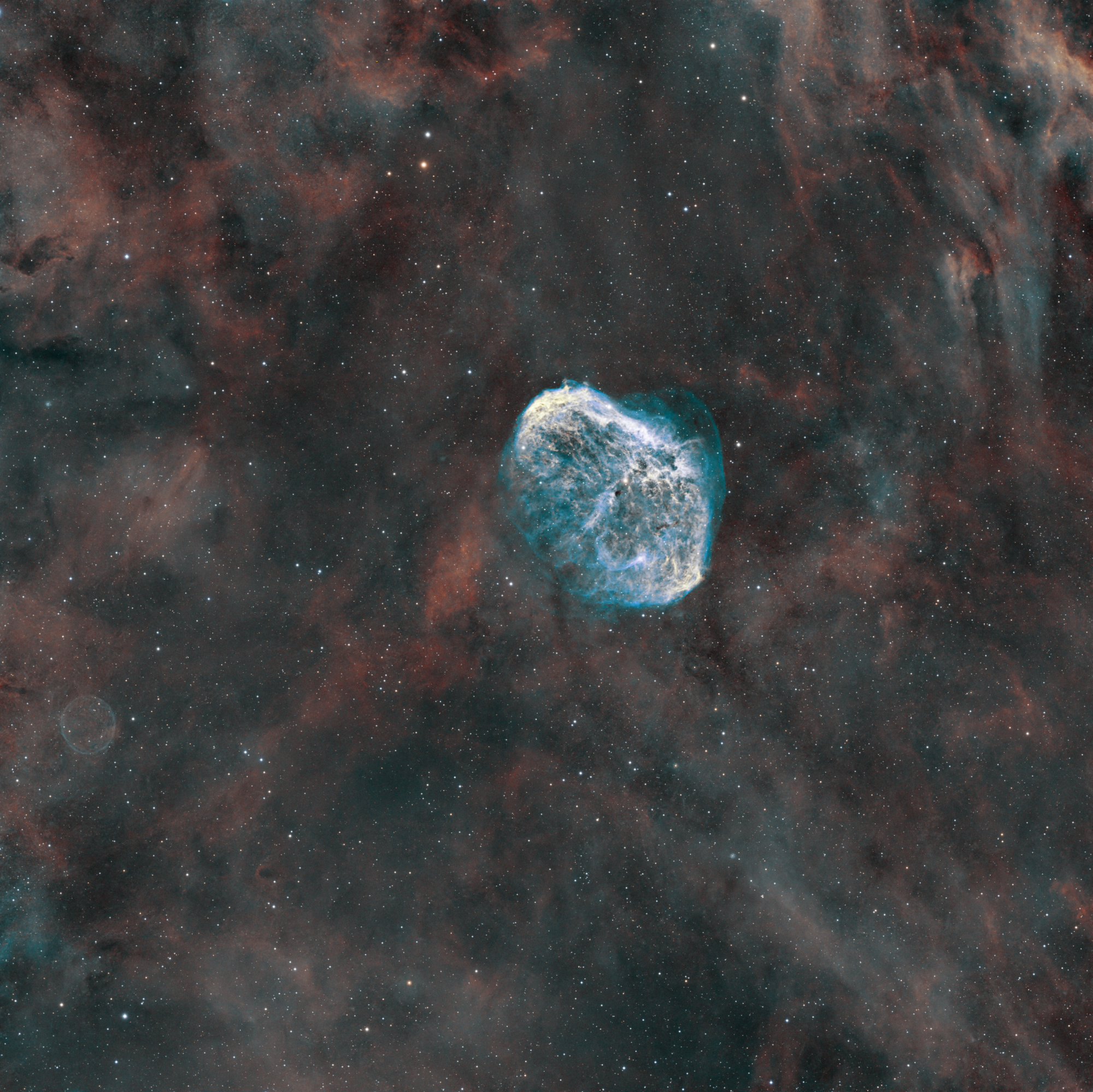
In the rich star fields of the Cygnus constellation, approximately 5,000 light-years from Earth, lies a glowing stellar wind symphony of gas and dust known as NGC 6888, or the Crescent Nebula. This stunning emission nebula is a product of stellar violence and cosmic artistry, shaped by the intense winds of a dying massive star. Its intricate structure and dynamic processes make it a favourite among astrophotographers and a fascinating subject for astrophysical research.
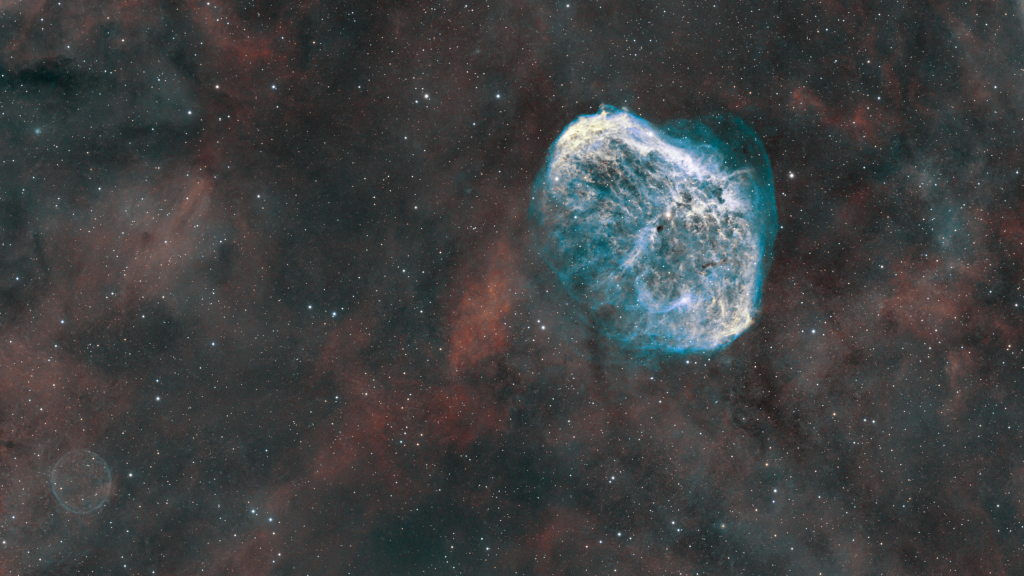
One of the things that continues to fascinate me in astrophotography is how the intended main target can provide very valuable insight into other targets. In the cropped version of the image seen above you might have spotted the small Bubble Nebula in the lower left-hand corner. At first glance I had framed my image in a way where only the upper half of the bubble was visible – hence I could not belive that there was anything there, since I could not find any evidence of it in Stellarium or Telescopius, which I usually use for planning.
But digging a bit on Astrobin.com made me realise that it was a thing hence I corrected my framing to include the Soap bubble nebula which it is called.
The autumn of 2025 has been quite sad, regarding observing time, mainly due to bad weather. It has been overcast for most of November and December. But I had two nights of clear skies by late September.
Observing the stellar wind symphony
With a forecast of only two clear nights I had to make the most of my time, and I decided to opt for a set of 300 s exposures as many as I could get over the course of those two nights. It turned out I could manage to acquire 51 subexposures of 300 seconds and 6 subexposures with an integration time of 120 seconds.
This was not nearly the amount of data that I had in mind but I was quite happy with what I managed to get.
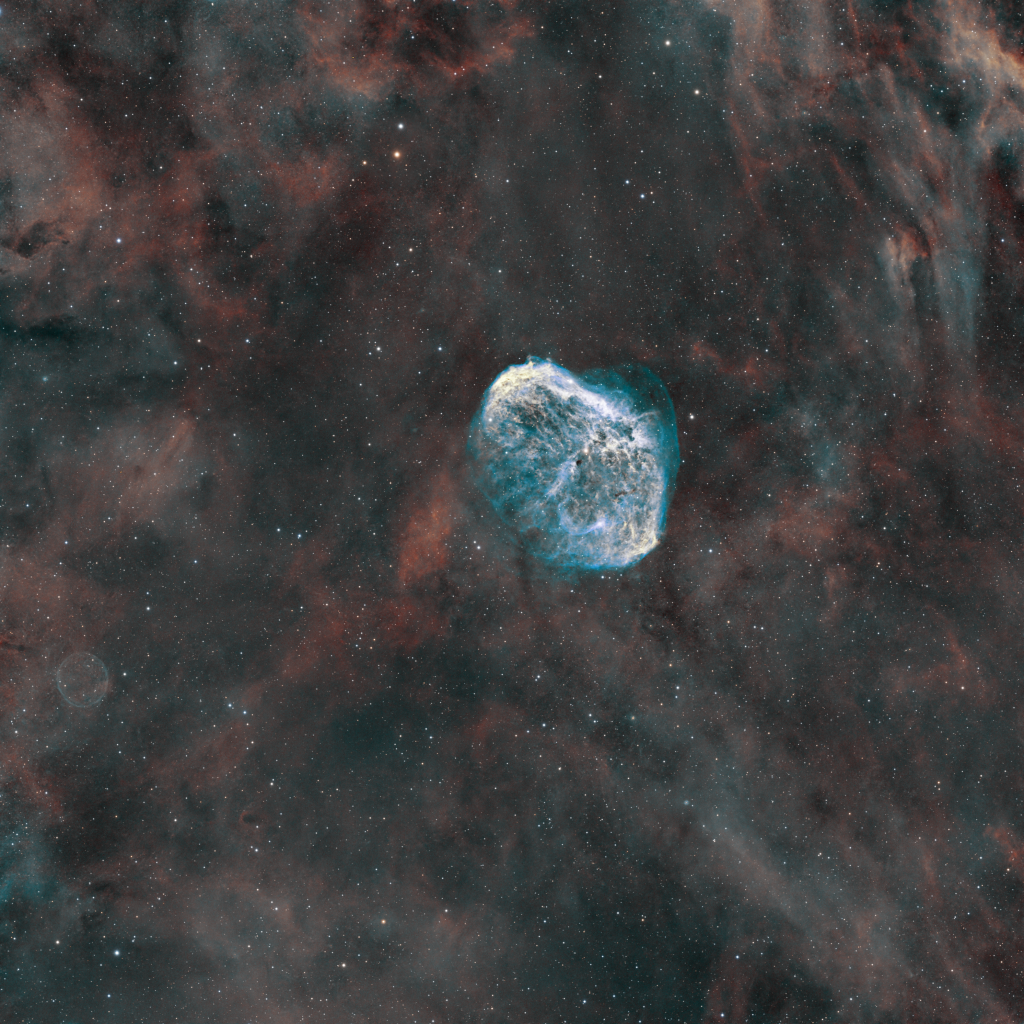
I usually require at least 100 images before I have a go at analysing the data and constructing an image to ensure a crisp and vibrant image. But the autumn has not been ideal for astrophotography here in Denmark. Despite having only recorded about half of the subexposures that I usually require, I had to see if my primary target and my secondary target still looked amazing in the Stellar Wind Symphony of the Crescent Nebula, NGC 6888.
Capturing the space brain
The data for this particular image of NGC 6888 were acquired over the two nights in late September 2025. During the first night, I collected a total of 29 subs with an integration time of 300s each. The second night, I managed to acquire 22 subs with an integration time of 300s and 6 subs with 120s integration time. Adding up to a total of 4 hours and 27 minutes.


The space brain – NGC 6888 is located in the constellation of Cygnus in a larger complex of nebulae, including the North American Nebula, which I have a post about here. However, it is very famous, and the usual facts about the nebula are available in several online sources.
Facts on the Crescent Nebula
Right Ascension: 20 12 7
Declination: +38 21 17.8
Distance: 5000 light-years
Apparent visual magnitude: 7.4
Apparent visual dimension: 0.30×0.20°
Constellation: Cygnus
Nebula diameter: approximately 25 light-years
Names: NGC 6888, Crescent Nebula, SH2-105 & C 27