
Table of Contents
In the northern hemisphere, during summer, when the nights are short and there is almost no darkness. Beautiful targets for astrophotography are high in the sky. One of the big nebulae is the North American Nebula – NGC 7000. This can be found within the constellation of Cygnus. Cygnus is visible from my backyard from July to November.
The constellation of Cygnus is one of my absolute favourite constellations, because it holds a lot of different nebulae, among these nebulae we find the North American Nebula, in which we can find the Cygnus Wall. The Cygnus Wall is a popular target amongst astrophotographers. On the website Astrobin.com, you can find other images of this target.
Last year, around the same time, I tried to photograph this part of the sky. You can read about my attempts at that time in my portfolio post here. At that time I had been taking photographs for about 5 months and had only acquired a star tracker. I have been imaging NGC 7000 several times, and every time, the Cygnus Wall keeps attracting my eye. In the gallery below, you can find all my previous attempts at photographing the nebula and the Cygnus Wall.

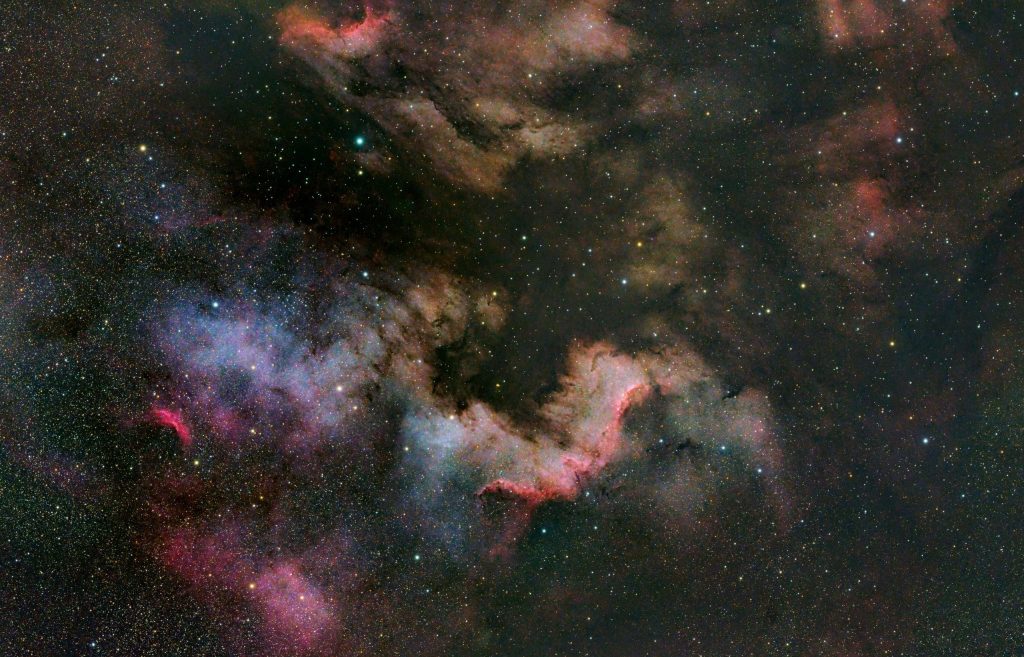


To be fair to the images above, none of them have been taken with a cooled astro camera, hence they are never going to be as detailed as an image taken with a dedicated camera. Another thing to note here is that the first image was taken with a Nikon Z5 unmodded through a 600 mm telephoto lens on a star tracker. The collected data summed to an integration time of about 5 hours. While the third image had an integration time of about 3.5 hours through a refractor telescope, the Askar 71F Flat-Field, but still with the Nikon Z5 unmodded camera, and mounted on the star tracker.
The North American Nebula
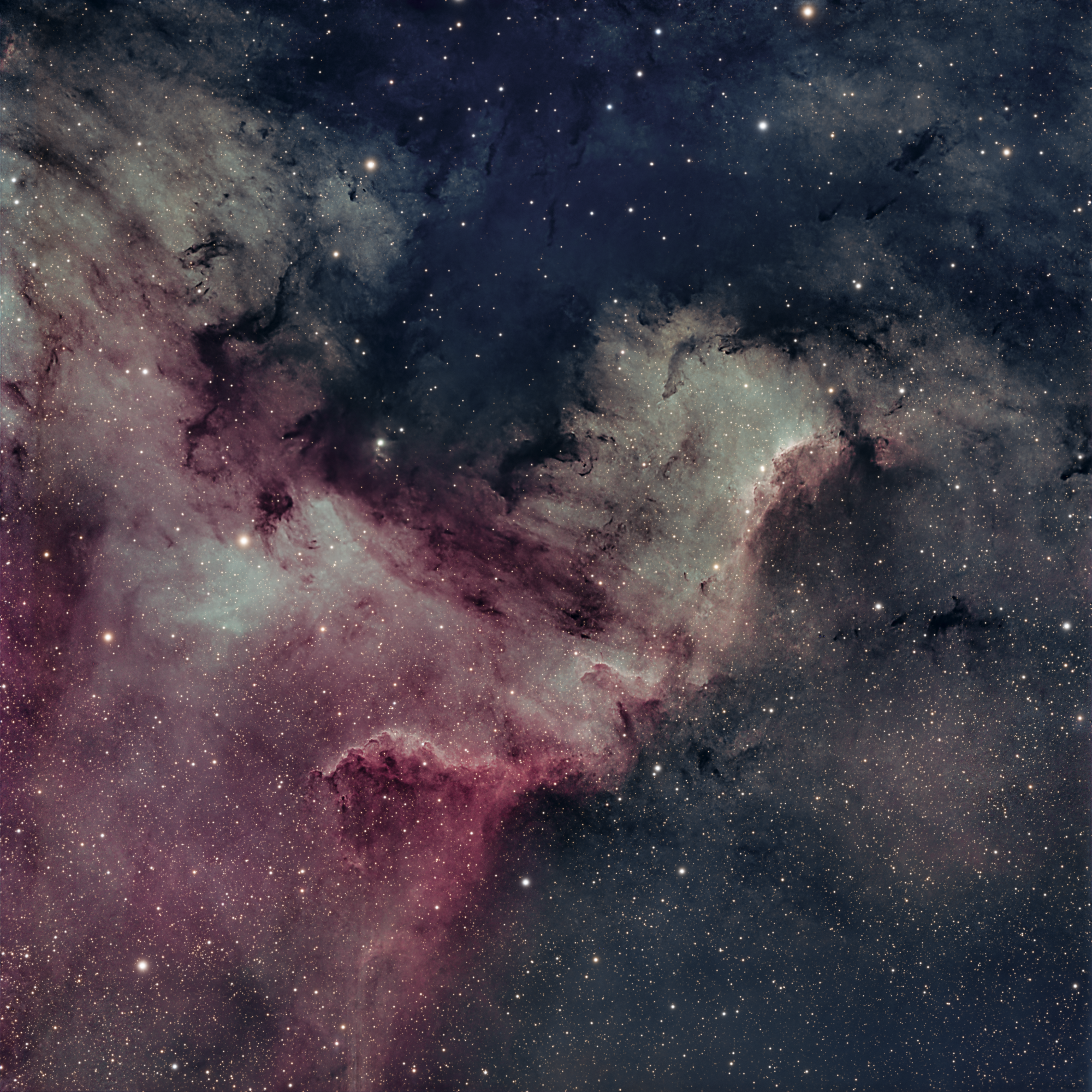
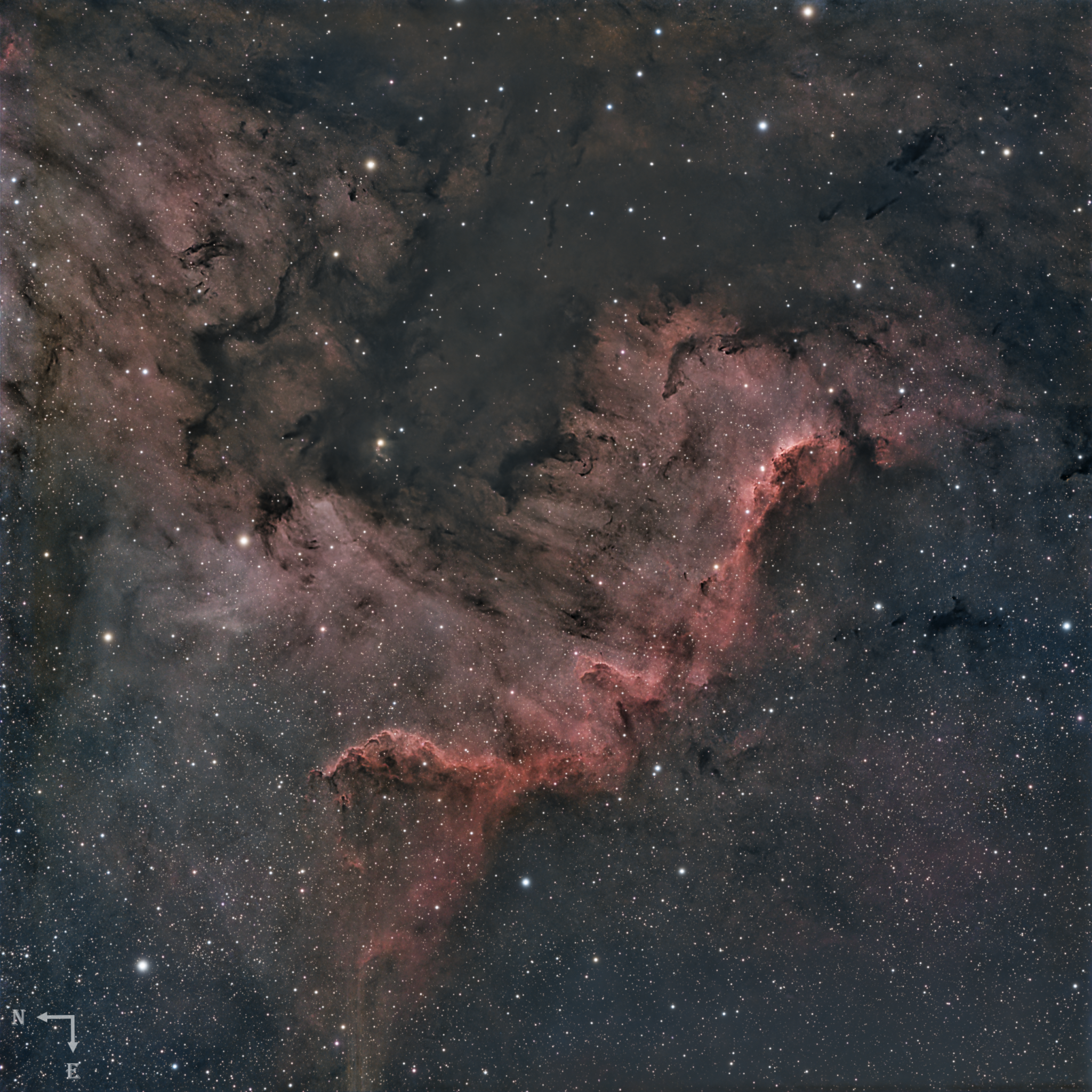
The current image has been taken with a new equipment lineup. This lineup is far more advanced than the previous equipment list. The setup now count the ZWO AM3 mount and a TC-40 tripod as the base. The scope was the Askar 71F Flat-Field refractor at a focal length of 490 mm, and the imaging camera is the ZWO ASI533MC Pro.
Over four nights from June to September, I have collected data, adding up to a total integration time of almost 15 hours. The images were stacked and processed using Pixinsight. I am very pleased with the resulting image that shows unprecedented details compared to previous images. There are two factors to this. The first one is the difference in camera, going from an unmodded, uncooled camera with large pixels to a dedicated cooled astro camera with a smaller pixel size, allowing for better resolving powers. Furthermore, the increase in exposure time will reveal more detail as more photons are collected.
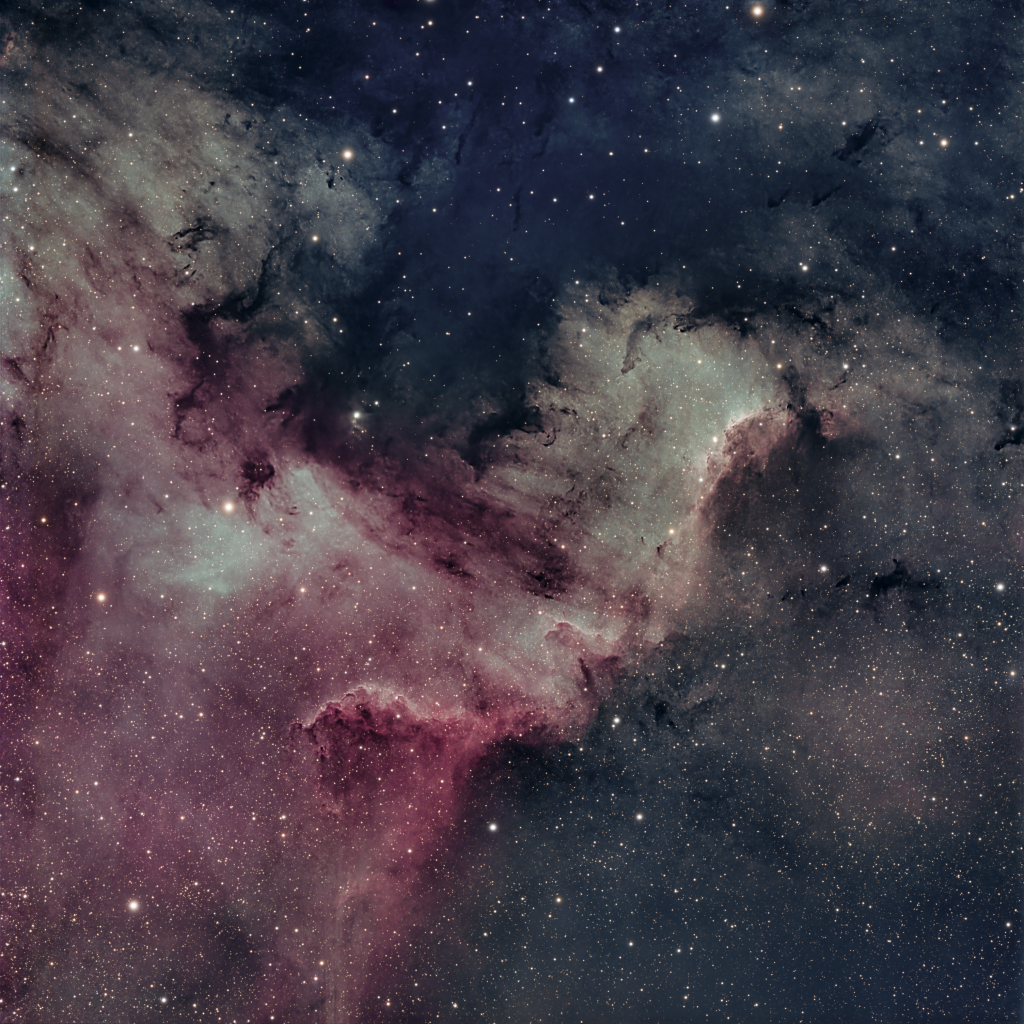
I am extremely satisfied with the result of this fourth attempt at photographing the Cygnus Wall within the North American Nebula. I wonder what the fifth version of this image should be – perhaps one where I have some filters, e.g. a set of dual-band filters to increase the contrast and get rid of the light pollution here at my Bortle 4 skies. For now, I think I will make a printed version of this image to hang on my wall.
Capturing the Cygnus Wall
The images for this particular image consist of 443 subframes, each exposed for 120 seconds, yielding a grand total of 14 hours and 46 minutes of exposure time on the Cygnus Wall.
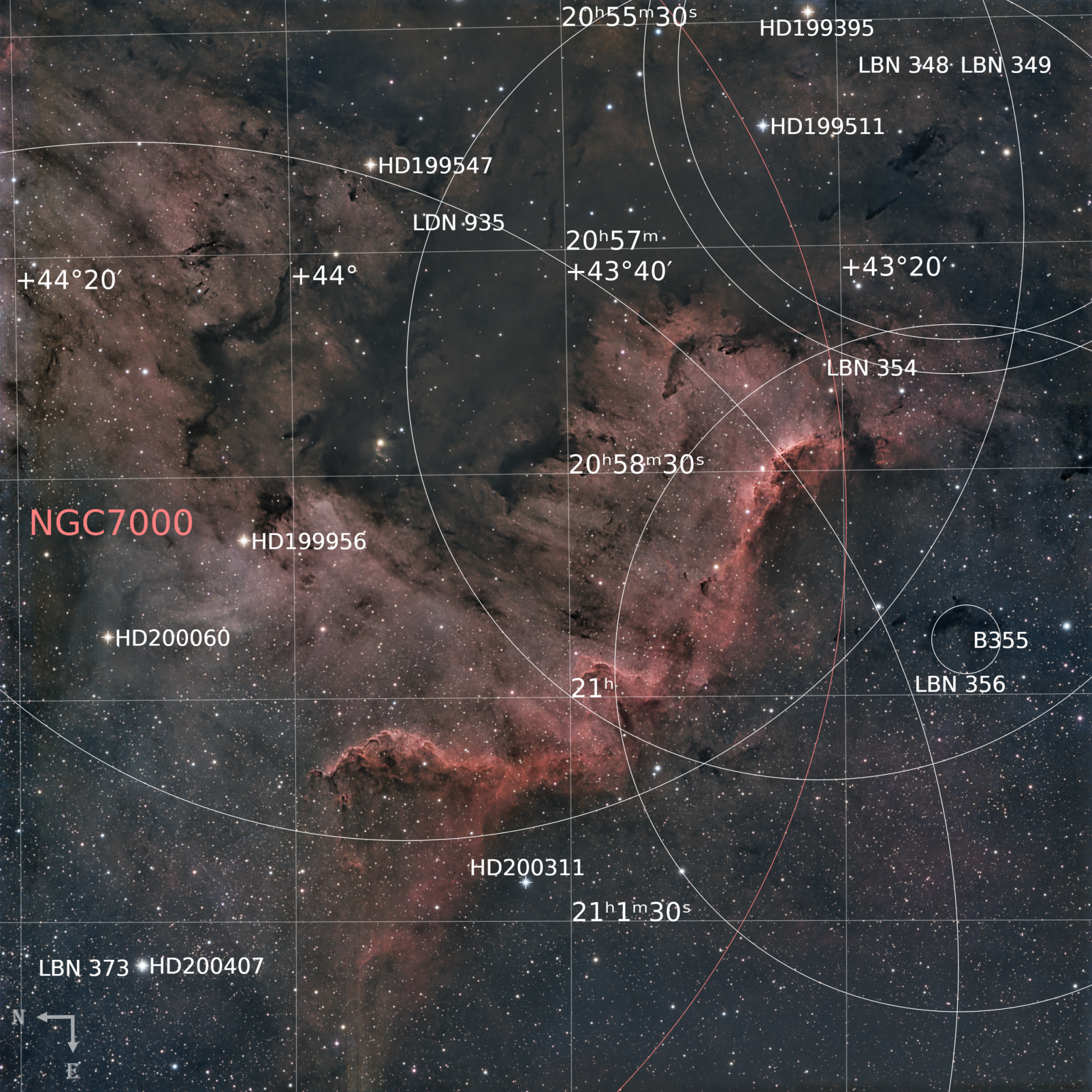
I usually provide some facts about the targets at the end of my posts, but for this target, I only have facts on the primary nebula, NGC 7000.
Facts on NGC 7000
Right Ascension: 20 58 59
Declination: +43 41 40
Distance: 2590 light-years
Apparent visual magnitude: 4.00
Apparent visual dimension: 2.00×1.67°
Constellation: Cygnus
Nebula radius: unknown
Names: North American Nebula, NGC 7000, SH2-117, Caldwell 20