Table of Contents
I have done it, having observed the night sky for more than a year without filters, and I just received the newest collection for my astrophotography rig. I have decided that I like to photograph nebulae very much, hence I have been seeking a nice set of filters to produce SHO images of those nebulae.
In Astrobin.com, there are many pictures taken with this particular filter and camera setup – click here to see some example images
However, I had some requirements for the filters.
Many dual-band filters cause halos on brighter stars; I wanted to avoid this. This meant that the band pass should be more narrow. Optolong has a great line up with the L-eNhance, the L-eXtreme and the L-Ultimate filters. The L-eNhance filter had wide bandpasses with 24 nm at OIII and Hydrogen-beta and 10 nm band pass for Hydrogen-alpha. This would most likely cause halos and would not remove the desired light pollution. The L-eXtreme on the other hand was far better at suppressing the light pollution with a 7 nm band pass at both OIII and Halpha. Finally, L-Ultimate has a band pass of only 3 nm on the desired lines, which were ideal for my purpose.
Filter requirements
Since I have a one-shot colour camera (OSC), the ZWO ASI533MC Pro. Having an OSC camera means that you cannot create Hubble palette images. Usually, you would have to do this with lots of different filters and a mono camera. However, modern dual-band filters let you collect several different wavelengths at the same time, hence optimising the time consumption for this type of work.
For quite some time I have my eyes set on the Askar Colour Magic filter set, since it allowed the perfect combination between narrow band pass and getting two filter one for Ha and OIII and the other for OII and SII, allowing for production of stunning Hubble pallette images. But these filters were prone to produce halos around brighter stars. Which I why I wanted to go with the Optolong L-Ultimate filter since it were less likely to cause halos. Unfortionately Optolong had no option for a dual band filter including the SII data. But recent rumours have it that Optolong is releasing the L-Synergy filter, which has already been reviewed by Luca – The Space Koala.
Choice of filter
This led me to a decision, I opted for the L-Ultimate filter as a starting point. In the image below I have recieved my filter and are ready to mount it in the telescope. I have threaded the filter inside the camera adaptor from Askar that came with the telescope, since I do not own a filter drawer nor a filter wheel.

I have settled with the Optolong L-Ultimate filter in the 2″ edition since it provides very clear separation between the background and the nebula. Because the band passes are very narrow. Below you can see the filter transmission curve from the manifacturer. This curve is very likely to remove unwanted signal from light pollution, which is somewhat prone here in the backyard.

Upgrade path
On the filter front I for sure will be adding an electronic filter wheel at some point in the near future. This will accommodate both the current filter, but also the future L-Synergy filter which I will be getting at some point. I should also get myself an UV/IR-Cut filter for my camera to be able to shoot broad band images, like galaxies etc.
Sample images
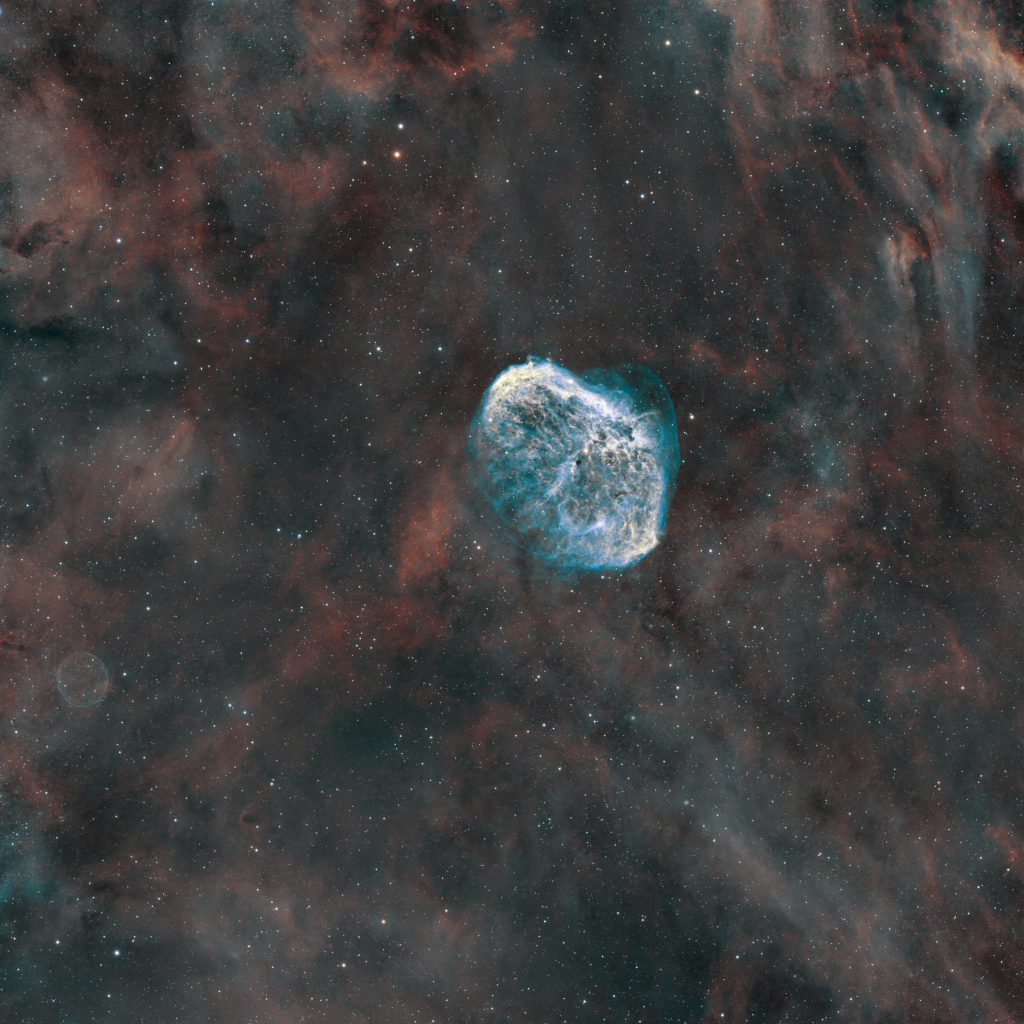
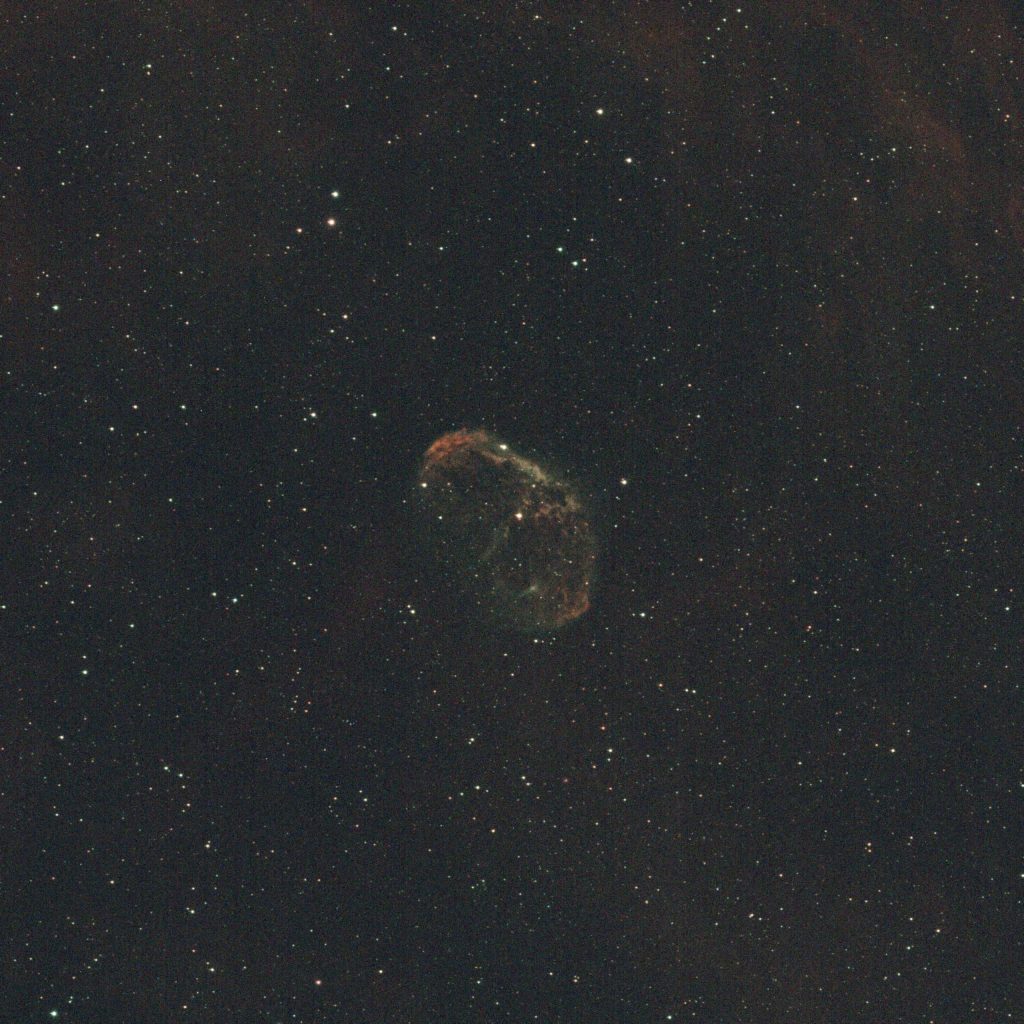
I have started to collect images for a nice little image of the Crescent Nebula. or the Smudge Nebula as I tent to call it, because my wife asked me the other night if I had made a smudge on my screen when I was observing this nebula. I told her what I was observing, however she seemed unimpressed by the nebula. Below you can see three different images the first one is a raw image while the second is a short stack of 59 images with a bit of processing applied to the image. The third image is the final image with multiple nights of data acquisition to it.
RAW IMAGE
SHORT STACK
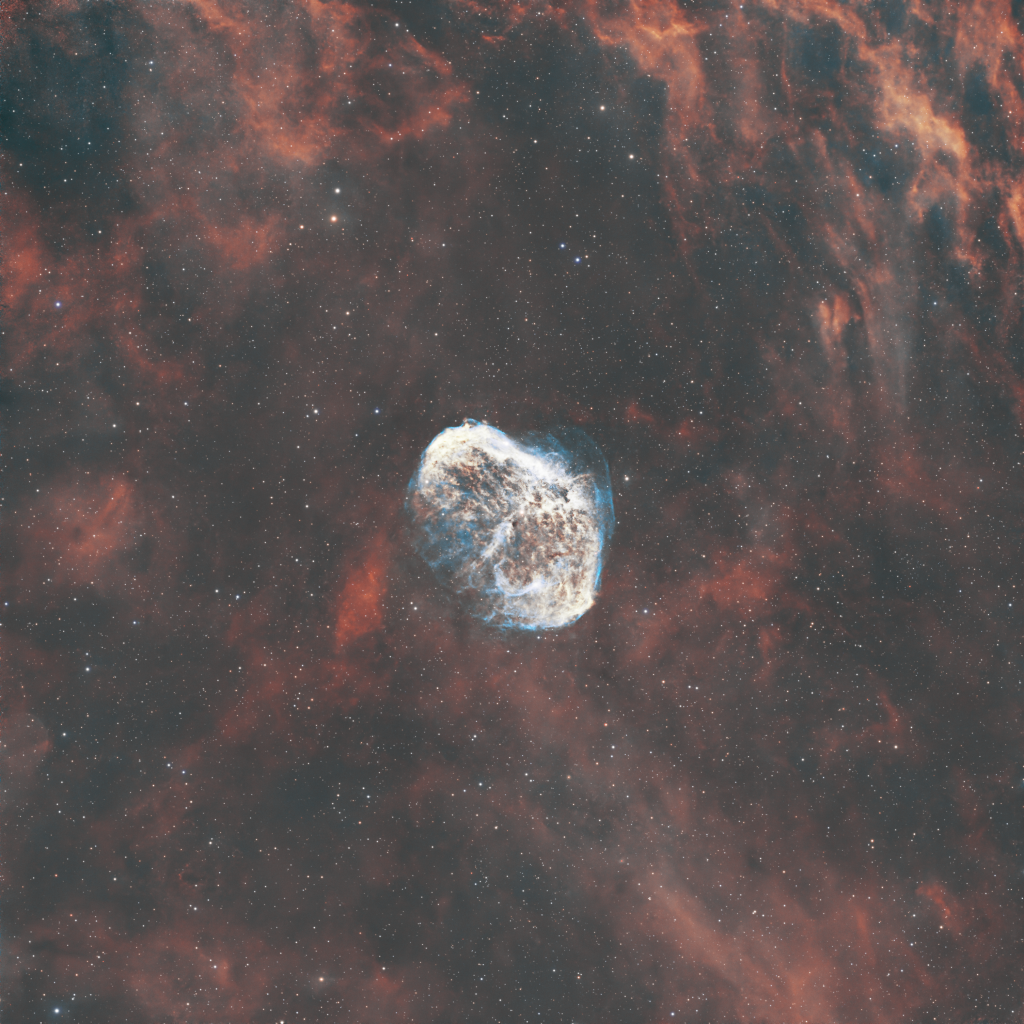
FINAL IMAGE